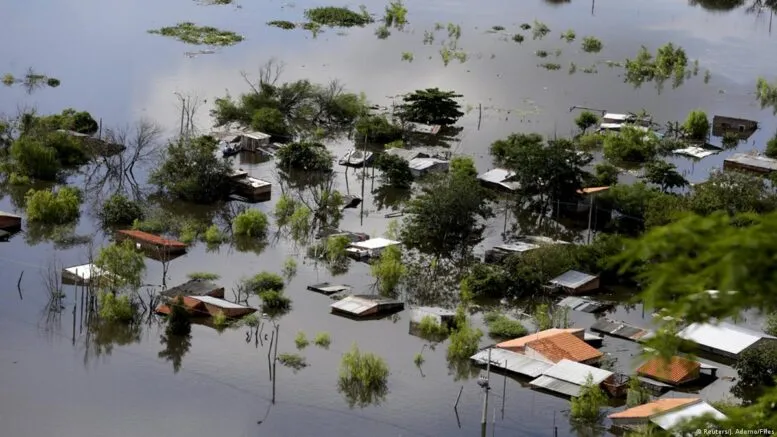
World Meteorological Organization has warned that a strong El Niño could develop from mid-2026, with rising Pacific Ocean temperatures signalling a shift in global climate patterns.
Forecasts show above-normal temperatures worldwide and varying rainfall impacts. WMO say confidence in the event is increasing, though uncertainties remain, with further updates expected to guide preparedness and response efforts globally.
In its latest climate update on Friday, the agency said there is growing confidence that conditions in the Equatorial Pacific are shifting, with sea-surface temperatures rising rapidly and signalling the possible onset of El Niño between May and July 2026.
Latest Stories
- IEBC registers 1.87 million new voters as drive nears deadline
- Kenya takes regional anti-corruption leadership as EACC CEO, Mohamud assumes top role
- Senate insists governors must defend county spending before committees
- Kenyan women still missing in top media leadership roles, new report shows
- Kenya lands Sh258 billion boost as AFC opens regional office in Nairobi
“After a period of neutral conditions at the start of the year, climate models are now strongly aligned, and there is high confidence in the onset of El Niño, followed by further intensification in the months that follow,” said Wilfran Moufouma Okia, Chief of Climate Prediction at the World Meteorological Organization.
He added that “models indicate that this may be a strong event, but the so-called spring predictability barrier is a challenge for the certainty of forecasts at this time of year. Forecast confidence generally improves after April.”
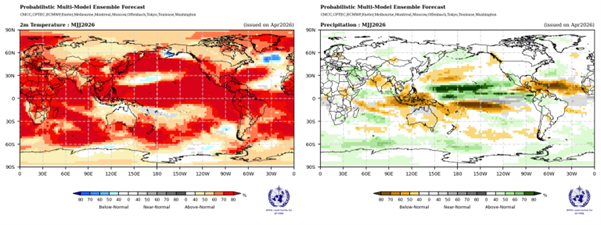 Probabilistic forecasts of surface air temperature and precipitation for the season May-July 2026. PHOTO/WMO
El Niño is a naturally occurring climate pattern characterized by the warming of ocean surface temperatures in the central and eastern Equatorial Pacific.
It typically occurs every two to seven years and lasts around nine to twelve months, influencing weather systems across the globe.
The phenomenon is part of the broader El Niño–Southern Oscillation (ENSO), one of the most powerful climate drivers on Earth, which alternates between El Niño and its opposite phase, La Niña.
According to the WMO, forecasts for the May–June–July period indicate a “nearly global dominance of above-normal land surface temperatures,” with particularly strong signals expected over southern North America, Central America, the Caribbean, Europe, and Northern Africa.
Rainfall patterns, however, are expected to vary significantly by region. Historically, El Niño events have been associated with increased rainfall in parts of southern South America, the southern United States, the Horn of Africa, and central Asia, while bringing drought conditions to Australia, Indonesia, and parts of southern Asia.
The organization also noted that during the boreal summer, warmer ocean conditions linked to El Niño can fuel hurricane activity in the central and eastern Pacific Ocean, while suppressing storm formation in the Atlantic Basin.
The warning comes as the world continues to experience rising global temperatures. The WMO pointed out that 2024 became the hottest year on record due to the combined effects of a powerful 2023–2024 El Niño and human-induced climate change.
While there is no evidence that climate change increases the frequency or intensity of El Niño events, scientists say it can amplify their impacts.
A warmer atmosphere and ocean provide more energy and moisture, increasing the likelihood of extreme weather events such as heatwaves and heavy rainfall.
The agency emphasized that each El Niño event is unique, with varying intensity, spatial patterns, and impacts, making accurate forecasting critical for preparedness.
Seasonal forecasts are particularly important for sectors sensitive to climate variability, including agriculture, water resource management, energy, and public health.
Governments and humanitarian organisations rely on such data to plan and respond to potential risks.
The WMO said it would release its next El Niño/La Niña update in late May, offering more detailed guidance for the June to August period and beyond.
This will incorporate input from global climate centres and expert consensus coordinated through international frameworks.
Regional climate outlook forums and national meteorological services are also expected to issue localised forecasts to help countries prepare for potential impacts.
As of early April 2026, the ENSO system remains in a neutral phase following the end of the 2025–2026 La Niña.
However, observations show near-average sea surface temperatures combined with increasing subsurface heat in the Equatorial Pacific, a key precursor to El Niño development.
Forecast models from multiple global centres suggest that neutral conditions will persist through the northern hemisphere spring before transitioning into El Niño during the summer and autumn, with the possibility of the event continuing through the end of the year.
The WMO said coordinated global efforts, including its seasonal outlook briefings and hydro-meteorological monitoring systems, are being used to support early warning and preparedness actions worldwide.


Comments
Sign in with Google to comment, reply, and like comments.
Continue with Google